
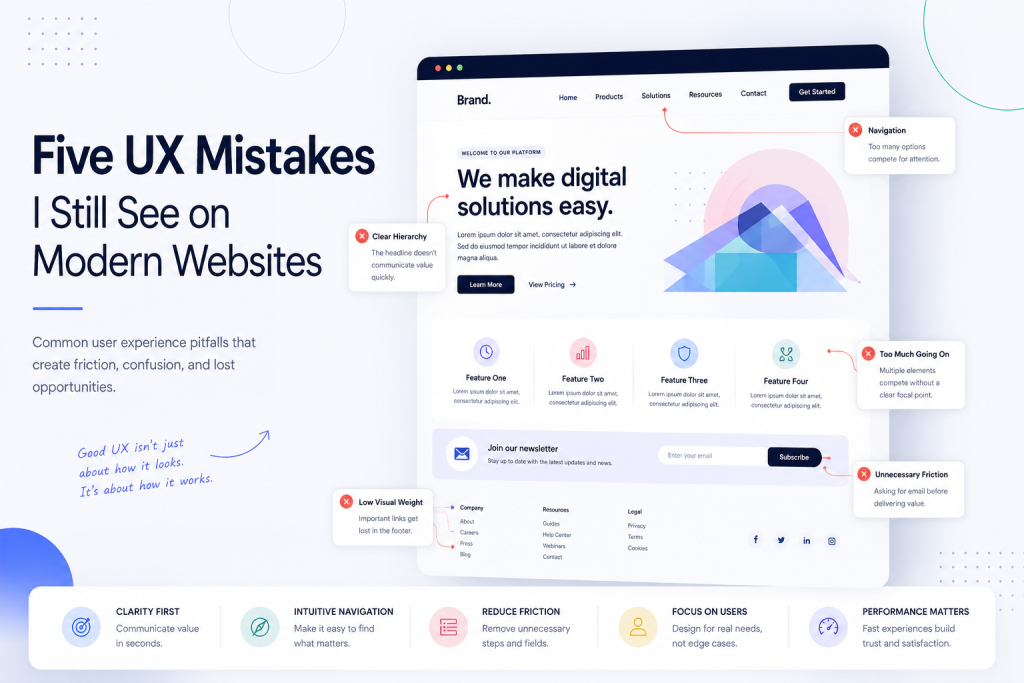
Despite advances in design tools, AI-assisted workflows, and increasingly sophisticated design systems, many websites still struggle with basic user experience issues. After reviewing a wide range of digital products, I’ve noticed a few recurring patterns that continue to create friction for users.
1. Prioritizing Visual Impact Over Clarity
Bold visuals and animations can help create a memorable first impression, but they shouldn’t compete with the primary message. Users should be able to quickly understand what a product or service offers and what action they should take next.
When aesthetics overshadow clarity, engagement often suffers.
2. Hiding Important Navigation
Minimal navigation can create a clean appearance, but users still need clear pathways through a website. Critical pages should never be difficult to find.
Navigation works best when it feels obvious rather than clever.
3. Overloading Forms
Every additional form field creates friction. Before asking users for information, it’s worth considering whether that data is truly necessary at that stage of the journey.
Reducing form complexity can significantly improve completion rates and overall user satisfaction.
4. Designing for Edge Cases Instead of Common Tasks
Teams sometimes spend considerable effort addressing rare scenarios while overlooking the most frequent user needs.
Effective UX starts with understanding the primary tasks users are trying to accomplish and optimizing those experiences first.
5. Ignoring Performance as a UX Issue
Speed is a user experience feature. Even well-designed interfaces can feel frustrating when pages load slowly or interactions lag.
Performance should be considered a core part of the design process rather than a technical afterthought.
Final Thoughts
Technology and design trends continue to evolve, but the fundamentals of good user experience remain remarkably consistent. Clear communication, intuitive navigation, efficient workflows, and fast performance are still among the most important factors in creating successful digital experiences.
As designers, our goal isn’t simply to create attractive interfaces—it’s to help users accomplish their goals with confidence and minimal friction.